
Insider Brief
- Chinese researchers funded by the National Natural Science Foundation of China and CPSF fellowships have developed a bio-inspired robotic gripper with a tunable energy barrier.
- The design, modeled after seed pods, enables rapid, low-force grasping and high-strength holding without continuous energy input, addressing limits of traditional soft and bistable grippers.
- Demonstrated on a drone that perched on branches while resisting wind without power, the technology could advance robotics in manufacturing, logistics, and aerial applications.
Chinese researchers backed by national science grants have developed a robotic gripper that mimics the way seed pods release their contents, offering a more efficient way for machines to grasp and hold objects. The project, supported by the National Natural Science Foundation of China and postdoctoral fellowships, could advance robotics in manufacturing, logistics, and aerial systems.
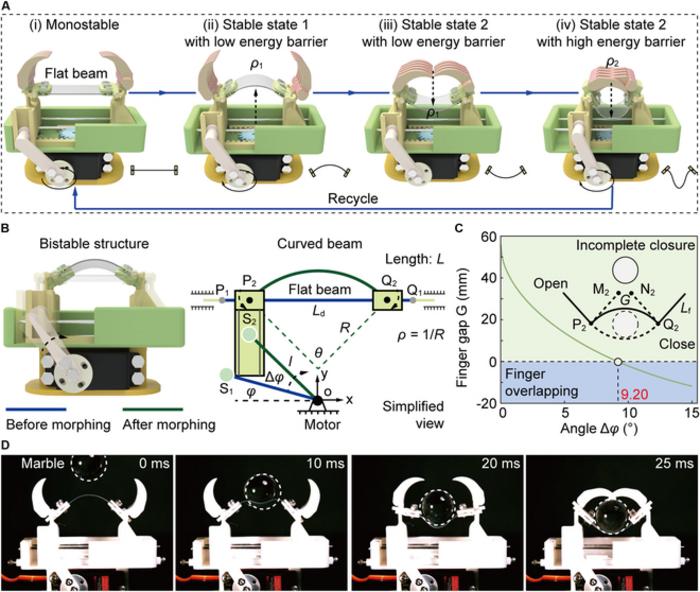
“Seed pods belonging to the genus Impatiens exhibit a remarkable energy barrier modulation mechanism. During growth, the pods maintain a high energy barrier to prevent premature seed dispersal,” explained Dr. Peng from Dalian University of Technology, China. “Upon maturation, the energy barrier is reduced considerably, making them highly sensitive to external stimuli. Consequently, even a raindrop can trigger the mature pods to explode, facilitating efficient seed dispersal. Inspired by this dynamic energy barrier modulation, our bistable robotic gripper achieves energy-efficient and sensitive manipulation.”
The robotic version uses an elastic beam mounted between finger-like extensions, controlled by a motorized shaft. By changing how much the beam bends, researchers indicated the system adjusts its energy barrier, switching between sensitive low-force grasping and high-strength holding.
According to researchers, tests showed the gripper could close with just 0.66 newtons of force in its low-barrier state, making it highly responsive. Once engaged, it could withstand more than 12 newtons of force, a nearly twenty-fold increase in holding strength. The team also mounted the gripper on a small drone, allowing it to perch on tree branches like a bird. In trials, the drone clamped onto branches, resisted strong winds without using energy, and released easily via Bluetooth control.
The team from Dalian University of Technology and Westlake University reported the findings in Research. The work was funded through multiple grants, including National Natural Science Foundation of China projects, as well as the CPSF postdoctoral fellowship program. The State Key Laboratory of Structural Analysis and the Research Center for Industries of the Future also contributed support, according to reseachers.
The approach suggests new ways for robots to interact with their environments. In factories, the technology could improve handling of fragile objects. In logistics, it could reduce energy use during repetitive lifting. In aerial robotics, it enables drones to land on natural or artificial structures to save power or deploy sensors.
“With its quick response, programmable interaction forces, and simple yet efficient design, our robotic gripper opens new avenues for next-generation robotic systems,” Wu added. “This unique mechanism can significantly expand the functionality of robots for diverse applications.”